How Bangladeshi Retailers Can Digitize Their Shops
A practical step-by-step guide to help Bangladeshi retailers digitize sales, inventory, payments, and reporting with the right retail software.
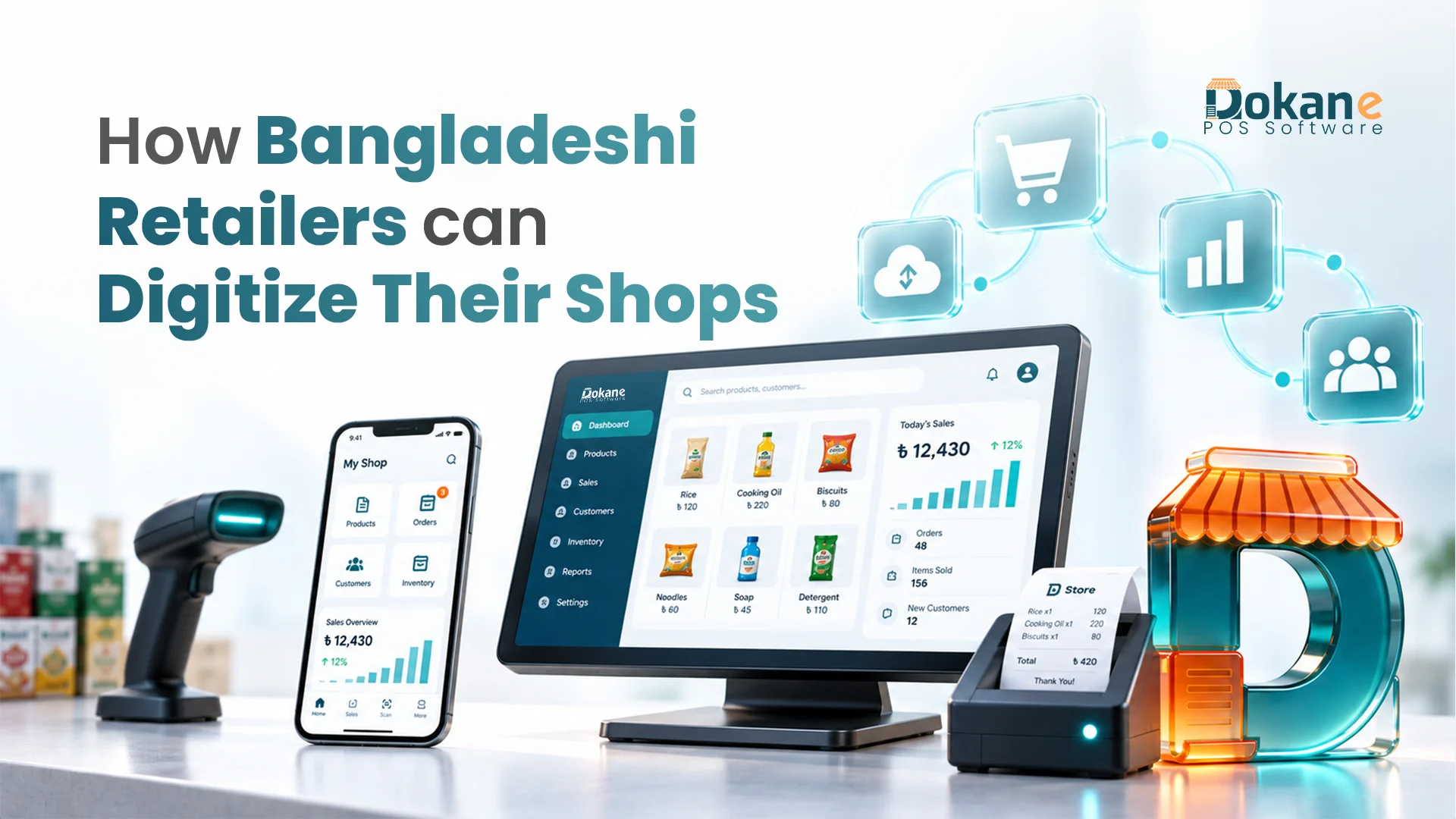
Walk down almost any market street in Bangladesh and you'll see the same thing: a shop owner doing mental math at the counter, a handwritten ledger tucked under the register, and a stack of cash that has to be counted, recounted, and carried to the bank by hand. It's not that these retailers are behind the times, it's that nobody ever handed them a practical, affordable way to do things differently.
That's the real starting point for any conversation about digitizing retail in Bangladesh. This isn't about chasing the latest tech trend. It's about closing a gap that's been sitting in plain sight for years and closing it in a way that actually fits how Bangladeshi shops operate.
The Scale of the Opportunity (and the Problem)
Bangladesh's retail sector isn't small. Recent research mapping the country's retail network counted close to 720,000 retail outlets spread across all 64 districts and industry estimates put the number of small and medium retailers nationwide at close to 8 million. That's the real backbone of the country's economy: not the big supershop chains, but the neighborhood grocery, the pharmacy, the mobile recharge counter, the tailor shop.
Here's the catch. Digital payments have made real progress at the counter, QR codes and mobile financial services have become a normal part of daily transactions in many shops. But that digital trail tends to stop right there. Once a shop owner needs to pay a distributor or restock inventory, most of that money reverts to cash, because the systems that would let digital payments flow smoothly further up the supply chain simply haven't caught up yet. The result is a strange in-between state: digitally-paying customers, but a business that still runs on paper and cash behind the counter.
Add to that a set of very real, practical barriers, inconsistent internet connectivity outside major cities, occasional power outages, limited digital literacy among staff, and understandable hesitation about learning new systems and it's easy to see why so many retailers have stayed on the sidelines, even when they know digitization would help.
None of these are reasons to give up on digitizing. They're just reasons to be realistic about how it needs to happen.
Why "Going Digital" Keeps Stalling for Small Retailers
Ask a shop owner why they haven't switched to digital systems, and the answer is rarely "I don't see the point." It's usually one of these:
- It feels complicated. Many retailers assume digital tools mean expensive hardware, IT staff, and weeks of setup — something built for large chains, not a single-counter shop.
- Staff are wary of change. Long-serving employees who've managed inventory by memory and habit for years can see new software as a threat, not a help.
- Data across the business is a mess. Product names, prices, and stock counts often live in different notebooks, different heads, or different WhatsApp messages, and no software works well on top of messy data.
- Past experiences with "high-tech" solutions went badly. Overcomplicated systems built for a different market, with features nobody needed, have understandably made some retailers cautious.
The retailers who successfully digitize don't try to fix all of this at once. They follow a much steadier path and that's genuinely good news for anyone starting from scratch.
A Realistic Path to Digitizing Your Shop
-
Start with the counter, not the whole business. The highest-impact, lowest-friction first step for most retailers is simple point-of-sale (POS) software; a system that records every sale, tracks stock in real time, and replaces the manual ledger. This alone typically eliminates the most common daily headache: not knowing exactly what's in stock or what actually sold today. What "the right system" looks like does shift by business type; a pharmacy POS software setup needs expiry-date and batch tracking that a clothing shop simply doesn't, while a supershop needs to handle a far larger product catalog at speed. Starting with the counter still applies either way; it's the features layered on top that should match your specific shop.
-
Get your product and pricing data in order. Before any software can help you, your products need consistent names, prices, and categories. This sounds unglamorous, but it's the step that determines whether digitization actually works or just becomes "one more thing to maintain."
-
Bring your staff along, don't just hand them a login. The shops that succeed treat this as a short training investment, not a one-time announcement. A half-day walkthrough of the new counter system, with someone answering real questions, does more for adoption than any manual.
-
Connect online and offline sales as soon as you're selling both. If you're active on Facebook, Instagram, or a Shopify store alongside your physical counter, keeping those inventories and sales records separate creates exactly the kind of stock mismatches and lost trust that frustrate customers. This is where good retail software in Bangladesh earns its keep; syncing what happens online with what happens at the till.
-
Let the data start working for you. Once sales and stock are tracked digitally, even a modest amount of reporting; best-selling items, slow-moving stock, daily totals; gives owners a clearer picture than years of manual tracking ever could. This is usually the point where digitization stops feeling like a chore and starts feeling like an advantage.
-
Expect connectivity hiccups, and plan around them. Given the real infrastructure gaps outside major cities, the right software for a Bangladeshi retailer should work reliably even through patchy internet or the occasional power cut; not require a perfect connection to function.
What Good Retail Software in Bangladesh Actually Looks Like
Not every POS or retail system built abroad translates well here, and "best" doesn't mean the same thing for every shop; what makes the best POS software in Bangladesh for a pharmacy looks different from what a fashion boutique needs. That said, the systems that genuinely work for Bangladeshi shop owners tend to share a few things in common:
- Built for local realities — VAT handling, Bangla-language support, and familiarity with how a supershop, pharmacy, or fashion store here actually operates, not a generic template.
- Simple enough for a small team to run without a dedicated IT person.
- Reliable under imperfect conditions — because "the internet was down" can't be an excuse for lost sales data.
- Able to grow with the business — from a single counter to multiple branches and an online storefront, without needing to switch systems later.
This is exactly the gap that's pushed retail software used in Bangladesh to evolve quickly over the past few years; moving away from imported, one-size-fits-all platforms toward tools actually built around local retail.
Digitizing Doesn't Mean Starting Over
Perhaps the most reassuring thing to understand about this whole process: digitizing a shop doesn't mean replacing everything you know about your business. It means giving your existing knowledge; what sells, who your regular customers are, how your shop actually runs day to day; a system that remembers it accurately, so you're not carrying all of it in your head or in a notebook that can be lost, damaged, or simply hard to read six months later.
The shops that make this shift aren't necessarily the biggest or the most tech-savvy. They're the ones who started small, picked a system built for how they actually work, and gave their team time to get comfortable with it.
If you're a retailer in Bangladesh thinking about where to start, DokanE POS was built around exactly this problem; practical, locally-relevant retail software that connects your counter, your inventory, and your online store, without asking you to become a technology expert to use it. Whether you're running a supershop, a pharmacy that needs solid batch and expiry tracking, or a fashion outlet juggling both a physical counter and a Shopify store, the setup adapts to your shop rather than the other way around.
Ready to see what digitizing your shop could actually look like? Book a demo with DokanE and find out.